
Controls
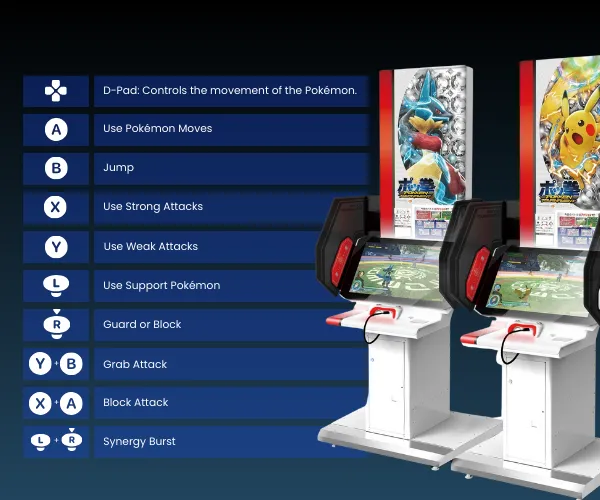
The Pokkén Tournament uses a wired controller with a D-pad on the left, 4 buttons on the right, and two paddle buttons, one on each side at the top.
D-Pad: Controls the movement of the Pokémon. If you double tap a direction, the Pokémon will dash towards that direction.
A: Use Pokémon Moves
B: Jump
X: Use Strong Attacks
Y: Use Weak Attacks
L: Use Support Pokémon
R: Guard or Block
Y + B: Grab Attack
X + A: Block Attack
L + R: Synergy Burst. If you press L+R again during Synergy Burst, you can use your Burst Attack.
Game Mechanics
Phases
In Pokkén Tournament, the battle system includes two distinct phases that shift during the match: 1) Field Phase and 2) Duel Phase. These phases affect how the Pokémon move and fight.
Field Phase: During this phase, the view is more open and 3D, allowing Pokémon to move around freely in all directions. It resembles a third-person shooter, where you can roam and distance yourself from the opponent. Players can use ranged attacks and focus on maneuvering around the battlefield, trying to find openings to land attacks or to evade.
Duel Phase: This phase is more like traditional fighting games, with a 2D view.. The movement is more restricted, primarily back and forth, similar to games like Street Fighter. Here, the combat is up-close. Players engage more directly, trying to outmaneuver and overpower their opponents with strategic close-range fighting.
The game switches between these phases based on certain moves or conditions met during the battle. Mastering when and how to transition between Field and Duel Phases is a key part of the strategy in Pokkén Tournament.
There are 3 ways to shift from Duel Phase to Field Phase:
Shifting from Duel Phase to Field Phase in Pokkén Tournament can be thought of as resetting the fight to give both players a bit more room to maneuver.
Here’s how you can make this shift happen in simple terms:
Using Phase Shift Points: Every time your Pokémon gets hit in Duel Phase, it accumulates something called phase shift points. Think of these points as a kind of pressure gauge. Once your Pokémon takes enough hits and the gauge fills up (reaching 12 points), the game automatically moves from the close-up Duel Phase back to the more spacious Field Phase. You don't need to track these points yourself; just know that after a series of hits, the phase will shift.
Executing a Long Combo: If you manage to hit your opponent with a long series of moves that connect one after the other without them breaking free — specifically, a combo of 21 hits — this will also change the phase from Duel to Field. It’s like the game rewards you for a well-executed attack sequence by opening up more space.
Performing a Normal Grab: This is a more straightforward method. During the Duel Phase, if you successfully grab your opponent (which usually involves a specific button press or control move), the game will shift back to Field Phase. This is a tactical move to switch phases without needing to rely on complex combos or accumulating points.
Attack Triangle
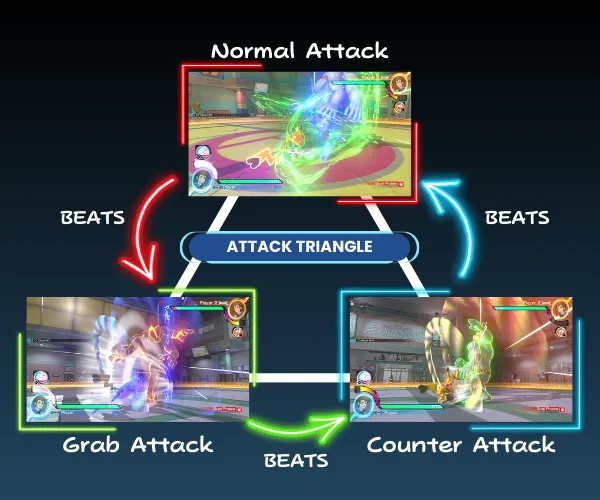
Pokkén Tournament uses a simple system to explain how different types of attacks interact, similar to the game of rock-paper-scissors, but with a twist. Here's a breakdown that’s easy to understand:
Types of Attacks:
Normal Attacks: These are your basic attacks, with no special color. They beat grabs.
Grabs: These attacks are shown in green and they beat counter attacks.
Counter Attacks: These are colored blue and they beat normal attacks.
What Happens When You Win an Attack Exchange:
Winning a matchup in this "attack triangle" (like rock beats scissors) gives you a "critical hit." This means you do more damage than usual, and sometimes it even changes how your move behaves, making it more effective.
Beyond the Basics:
While the game starts off feeling like rock-paper-scissors, there's more complexity as you learn. There are exceptions to the rules of the attack triangle which add depth and fun to the game.
Counter Attacks: Think of these not as invincible moves, but as moves that can absorb a hit right at the start (similar to some special moves in other fighting games). They’re not unbeatable; you can still grab someone out of a counter attack, or use quicker normal attacks to disrupt them.
During the slow motion part of a counter attack, you can switch to a different move or dodge, escaping or countering the counter attack.
Some moves are designed specifically to break through counter attacks, called "counter pierces".
Grab Attacks
In Pokkén Tournament, understanding when and how to use grabs is important but can be a bit tricky:
Grabs vs. Counter Attacks: Grabs are effective against counter attacks, but only if the grab is executed perfectly. This means the grab must be timed and aimed correctly so that it connects. If a counter attack is well-timed or well-placed, it can still beat a grab.
Challenges with Grabs: Grabs are generally vulnerable to normal attacks. This means if your opponent uses a normal attack while you're trying to grab, they'll likely interrupt and beat your grab. However, you can improve your chances of a successful grab by timing it to catch an opponent just as they're getting up from a knockdown—this is often called a "meaty" attack. While this tactic can help, some moves specifically designed to beat grabs will still do so, regardless of your timing.
Enhancing Grab Effectiveness: To make your grabs more effective and safer, you can set them up with additional support. For example, using a support character or certain special setups specific to your character can protect you if your grab attempt is countered.
Risk vs. Reward: Using grabs involves significant risk because if your opponent counters with a normal attack, you can lose a lot of health. However, mastering the use of grabs, especially by spacing them well and using them judiciously with characters that control space effectively, can significantly enhance your gameplay strategy.
Welcome to PokéChest, your ultimate destination for Pokémon TCG and beyond! We also have an extensive range of toys and stationary featuring Sanrio and other Japanese anime for you to explore! For those seeking for thrilling game experiences, check out our Pokkén Tournament Arcades and gashapon machines in store!
Visit Us In Store
Address:
Unit 841-5300 No. 3 Road, Richmond BC (Located inside Lansdowne Centre)
Store Phone Number:
604-902-8746
Copyright 2024. All Rights Reserved. PokéChest.